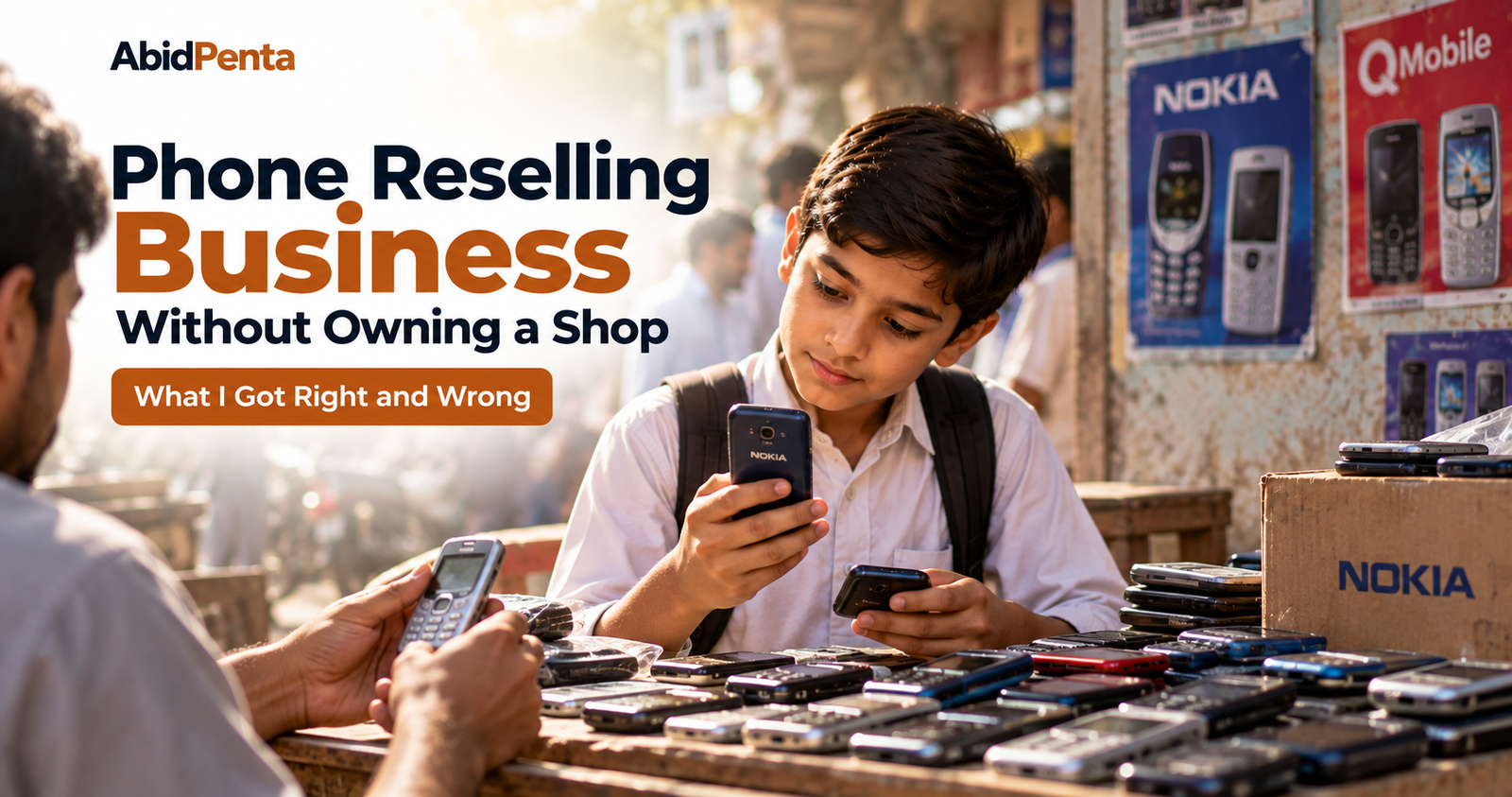
Before I opened Ali Mobile Center, I was already buying and selling mobile phones.
I was still in school.
This was around 2009 to 2011, during a period when Nokia phones were everywhere around me, alongside QMobile and different Chinese phones.
But there was an important detail.
I did not initially own a mobile shop.
I was involved informally in the market, buying and selling phones and dealing around buyers, sellers, dealers, and resellers.
Looking back, that period taught me something I did not understand formally at the time:
You can participate in a market before taking on the full cost structure of a traditional business.
Some parts of the way I operated were sensible.
Other parts I would handle much more systematically today.
I do not have detailed records from every phone I traded, so I will not invent exact profits, losses, purchase prices, or individual deals. When I talk about what I got right and wrong, I am looking back at the business model itself and asking what I would preserve and what I would improve with the experience I have now.
What I Got Right: I Did Not Wait for a Shop
For a long time, I associated business with a physical place.
A shop looked like a real business.
A counter, signboard, shelves, and fixed location made something feel established.
But my early mobile trading experience showed me another possibility before I had language for it.
A transaction can happen without owning a storefront.
I could find a phone, understand the opportunity, connect with people in the market, buy, and later sell.
The shop was not the business.
The transaction was the business.
That distinction is even more relevant today.
The U.S. Small Business Administration lists office space, utilities, equipment, inventory, licenses, insurance, and other expenses among the costs entrepreneurs may need to consider when starting a business. A brick and mortar operation can therefore create costs before enough sales exist to support them. The SBA’s startup cost guidance explains these different expense categories.
I was not consciously applying a low overhead strategy as a school student.
I simply did not have a shop yet.
But in hindsight, that limitation also protected me from taking on certain fixed expenses too early.
A Shop and a Market Are Not the Same Thing
This was one of the deeper lessons.
You can have access to a market without owning the place where that market operates.
I was around people who bought phones.
People who sold phones.
Dealers.
Resellers.
The activity already existed.
My job was not to create the entire market.
I had to find where I could participate in it.
That is an important distinction for someone starting a business today.
Sometimes beginners immediately think they need to create everything:
A company office.
A website.
Branding.
Equipment.
Staff.
A perfect system.
Those things may become necessary later.
But the first question should be more fundamental:
Where does the actual exchange of value happen?
For me at that stage, it happened through individual phones and people already active in the mobile market.
I would later open a physical mobile shop, but that is another chapter of the story.
Before that happened, I had already discovered that owning premises and participating in commerce were two different things.
What I Got Right: Each Phone Was Its Own Decision
A useful characteristic of phone trading was that every device forced a decision.
Should I buy this phone?
What condition is it in?
What is a sensible buying price?
Who might want it?
How easily might it sell?
What problem could turn an apparently good purchase into a bad one?
That way of thinking is different from filling an entire store with inventory and hoping everything moves.
Each phone could be considered individually.
I think this is useful for anyone starting a reselling business.
Do not think only in terms of:
“I am entering the phone business.”
Think about the individual transaction in front of you.
A business can sound attractive in general while a specific deal inside that business is poor.
You do not make money because the category is attractive.
You still have to make sensible decisions one transaction at a time.
What I Would Do Differently: Create a Record for Every Deal
This is one area where I would be much more disciplined today.
I do not have a detailed transaction ledger from those years.
Because of that, I cannot accurately tell you which model produced the best results, how long individual phones remained with me, or what the exact outcome of each transaction was.
Today I would record every phone.
Not because I enjoy spreadsheets.
Because memory is a poor accounting system.
For each device, I would keep a very simple record:
Purchase date
Phone model
Device identifier where appropriate
Purchase price
Any repair or preparation cost
Other direct costs
Sale date
Sale price
Who the source type was, such as private seller or dealer
How many days I held the device
Any problem discovered after purchase
That information would give me something memory cannot.
Evidence.
After 20 or 30 transactions, I could see which kinds of deals worked better and which ones created trouble.
I would not have to rely on the feeling that I was doing well.
I could look at the record.
This is deliberately different from the lesson I previously shared about profit and margin.
The point here is not how to calculate profitability.
The point is deal memory.
If you trade individual assets, create a history of those assets.
What I Would Do Differently: Inspect Before Thinking About the Upside
When you want to make a deal, it is easy to focus on what you might earn after selling.
That can make you less interested in discovering reasons not to buy.
Today I would reverse that mindset.
Before asking:
“How much can I make?”
I would ask:
“What could make this phone difficult or impossible to resell?”
Modern secondhand phones have considerably more technical complexity than the phones I dealt with during that period.
Current CTIA guidance recommends checking a secondhand device’s status, physical condition, functionality, refund protection, and network compatibility. It also points buyers to device status checking tools for identifying phones reported lost or stolen. CTIA’s secondhand device guidance explains these checks.
That creates a good general principle even beyond phones:
Before buying an asset for resale, understand what could destroy its resale value.
The attractive side of a deal is usually obvious.
The risks deserve deliberate attention.
A Good Purchase Needs an Exit
If I were reselling phones today, one of my rules would be:
Do not become excited about acquiring something before thinking about how it will leave your hands.
Buying feels like action.
But a reseller is not trying to build a personal collection.
The product eventually needs another owner.
Before purchasing, I would want to understand:
Who is likely to buy this?
How common is the model?
What condition does the next buyer expect?
Where can I realistically sell it?
What price range is actually being accepted?
What could make the device remain unsold?
This is not about predicting the future perfectly.
It is about having an exit hypothesis before committing money.
Current phone reselling guides tend to emphasize sourcing, inspection, pricing, selling channels, returns, and inventory turnover for exactly this reason. The work is not finished when the reseller acquires the device.
What I Got Right: I Stayed Close to Transactions
Not having a shop meant I could not depend on customers simply walking through my door.
The business had to revolve around actual opportunities.
A phone became available.
Someone wanted a phone.
A dealer had information.
A buyer had an interest.
A transaction required movement.
There is something useful in that.
Businesses sometimes become surrounded by activities that feel productive but are far away from the transaction itself.
Meetings.
Brand discussions.
Tools.
Dashboards.
Planning.
None of those are automatically bad.
But they can create the feeling of building a business without enough actual buying or selling happening.
My early phone trading was much less sophisticated.
It was close to the transaction.
For a new entrepreneur, that proximity can be valuable.
You quickly discover whether there is a real exchange taking place.
What I Would Do Differently: Protect Against Information Gaps
A reseller can be at a disadvantage when the other person knows more about the product.
That is especially dangerous with used goods.
The seller knows how the phone has been used.
You may see it for only a few minutes.
That difference creates information risk.
Today I would use a repeatable inspection process instead of relying only on a quick look or general confidence.
For a modern used phone, that could include checking the physical device, functionality, charging, account status, device identifier, carrier compatibility, and any available lost or stolen status information.
CTIA operates its Stolen Phone Checker program specifically to help consumers and commercial users determine whether a mobile device has been reported lost or stolen before purchase.
If buying through an online marketplace, the FTC also recommends reviewing the actual item photos and description, understanding refund policies, keeping records, and using safer payment methods where protections are available. The FTC provides current guidance for buying through online marketplaces.
These are modern safeguards.
I did not have this same environment or these same tools during my early mobile trading years.
But the underlying lesson is timeless:
The less you know about what you are buying, the more careful your process needs to become.
What I Would Not Change: Starting Before I Had Everything
If I had believed that I first needed a complete shop, staff, sophisticated systems, and a large stock of phones, my experience would have been very different.
Instead, I participated before I owned the infrastructure.
That does not mean every business should avoid premises.
Some businesses genuinely need them.
It means infrastructure should follow the needs of the business rather than becoming proof that the business is real.
This connects with something I shared in the story of my first small business from home.
I had already experienced business before having the kind of setup people often associate with a formal company.
The mobile market reinforced that lesson in a completely different environment.
The Model I Would Use Today
If I were starting a small phone reselling operation today, I would keep the first stage simple.
I would choose a narrow group of devices I understood.
I would set a maximum amount of money I was willing to have tied up at one time.
I would create one inspection checklist.
I would record every purchase and sale.
I would know where I planned to sell before buying.
I would avoid taking on premises until the transaction volume genuinely justified the additional fixed cost.
I would review my completed deals regularly and look for patterns.
And most importantly, I would treat every purchase as a decision that must stand on its own.
A weak deal does not become strong because you call yourself a business owner.
The Part I Got Right and the Part I Would Improve
Looking back, I think the strongest part of that period was simplicity.
I was buying and selling phones before I owned a mobile shop.
There was less infrastructure between me and the actual transaction.
What I would improve today is the system around those transactions.
Better records.
A consistent inspection process.
Clearer purchasing criteria.
A planned exit before committing money.
More protection against information gaps.
I would keep the low overhead mindset.
I would add much more discipline.
That combination is the real lesson I take from this period.
You do not need to own a shop to begin trading. But once real money is moving, informal should not mean careless.
The location can wait.
The discipline should not.
Frequently Asked Questions
Can you start reselling phones without owning a shop?
Yes. A reseller can operate without a traditional storefront, depending on local laws, selling channels, and the business model. Avoiding premises may reduce some fixed costs, but inventory, device inspection, legal requirements, payments, returns, and other costs still need to be considered.
What should you check before buying a used phone for resale?
For modern devices, check physical condition, functionality, device status, account locks, compatibility, and relevant purchase protections. CTIA also recommends verifying that a secondhand device has not been reported lost or stolen.
Is buying a cheap phone automatically a good resale deal?
No. Purchase price is only one part of the decision. Condition, repair requirements, device status, marketability, likely selling price, and how long your money may remain tied up all matter.
Do resellers need transaction records?
Keeping records makes it easier to compare completed deals, track costs, identify recurring problems, and understand which types of transactions deserve more or less capital.
The Lesson
Before Ali Mobile Center existed, I was already participating in the mobile phone market.
That period changed how I think about what is required to begin a business.
A storefront can be useful.
It can create visibility, permanence, and a place to operate.
But it is not where entrepreneurship begins.
Entrepreneurship begins much closer to the transaction.
Something has value.
Someone is willing to sell it.
Someone else is willing to buy it.
And between those two points, you have to make a good decision.
I got the simplicity right.
Today, I would add far more structure around it.
That is the difference experience makes.