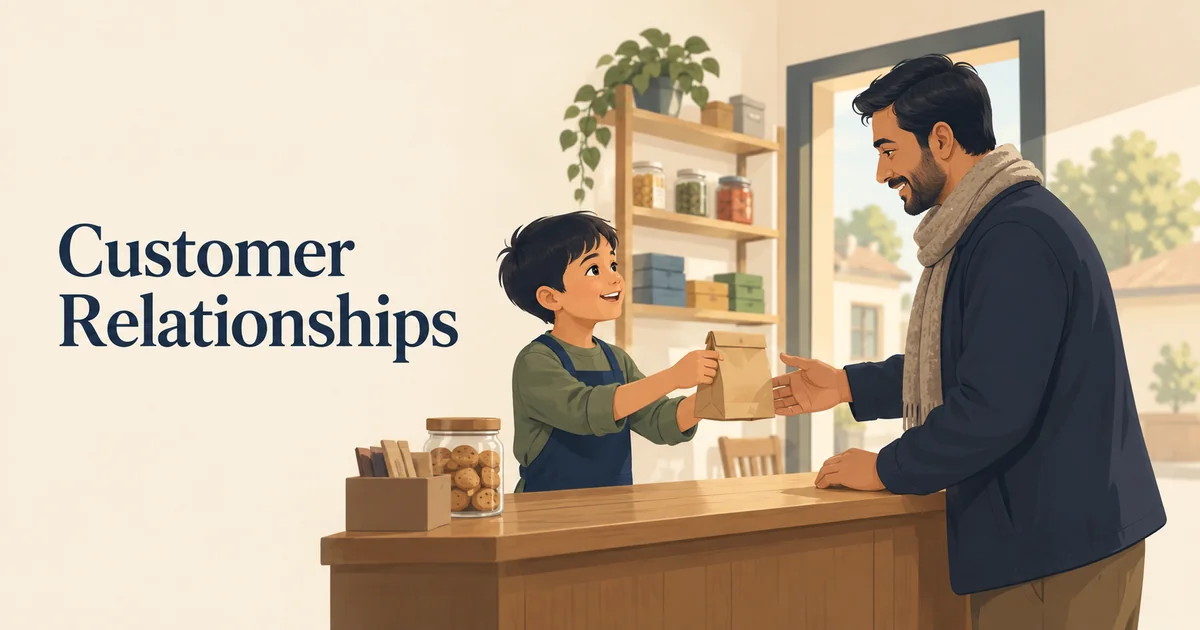
When your customers are also people from your own neighborhood, selling feels different.
You are not dealing with anonymous buyers who disappear after a transaction.
You may see the same people again. You may know their families. They may pass the shop regularly.
And because the business exists inside the same community where you live, the relationship does not end when someone walks away with a product.
I experienced this very early.
As a child, I sold products from a small room in our family home. I have already written about how that first small business started and the lessons I took from it.
This article is about something different.
Selling to people around me taught me something about customers that became much clearer later in life:
A customer is not simply a sale. A customer is a person having an experience with your business.
That distinction changes how you think about selling.
Familiar Customers Make Business More Personal
In a larger business, it is easy to reduce customers to numbers.
Orders.
Transactions.
Conversion rates.
Average purchase value.
Those numbers become useful as a business grows, but they can hide something important.
Every number represents a person.
My earliest experience of selling made that difficult to forget because many buyers were people from around us.
That meant I could not think only about completing a transaction.
The person still existed after the sale.
I might see them again.
That creates a different kind of awareness.
You begin to notice that the way someone is treated can matter beyond the product they bought.
This idea is still relevant in formal business planning today. The U.S. Small Business Administration includes customer relationships as a core part of a business model and recommends thinking about how customers interact with a business from start to finish. SBA guidance on customer relationships and business planning
Small businesses often experience that lesson directly before they ever describe it with business terminology.
Customers Do Not All Think the Same Way
Another thing becomes obvious when you deal with people directly.
Different customers behave differently.
One person may make a decision quickly.
Another may look carefully before buying.
Someone may already know exactly what they want.
Another person may need more time.
Even when two people are buying similar products, their reasons and behavior can be different.
This sounds simple, but it has an important business consequence.
A business should be careful about building its entire understanding of customers from one person’s behavior.
One customer is one customer.
A pattern requires more than one example.
Today, whether I am thinking about a physical business, a digital service, or AI Globia, I try to separate individual reactions from broader patterns.
That mindset started much earlier than I realized.
Selling Is Also About Reading the Situation
As a child, I did not study customer psychology.
I did not know formal sales frameworks.
But direct selling forces you to pay attention.
You notice whether someone already knows what they want.
You notice when someone is only looking.
You begin to understand that pushing every person toward a purchase is not always the best way to sell.
Sometimes the right approach is simply to answer clearly and let the person decide.
That idea has stayed with me.
Sales does not have to mean pressure.
Good selling often means understanding the situation well enough to know when to explain, when to answer, and when to stop talking.
Official SBA guidance on selling makes a similar practical point. It advises small business owners against immediately applying a hard sell and instead recommends starting with a simple conversation and understanding what the customer needs. SBA guidance on building customer relationships without a hard sell
A founder can easily become so interested in the product that every conversation turns into a presentation.
The customer may not need a presentation.
They may need one clear answer.
Familiarity Does Not Give You Permission to Become Careless
Selling inside your own community creates another lesson.
It can be easy to become casual with people you already know.
That can be dangerous.
Familiarity should not reduce the standard of how someone is treated.
In fact, repeat contact creates more accountability.
If someone has a poor experience with an anonymous seller, they may never meet that person again.
In a small community, you may see the same customer tomorrow.
That changes the relationship.
It reminds you that business behavior has a memory.
The way you communicate today can affect the next interaction.
This does not require complicated customer relationship software.
It begins with something simpler:
Treating each interaction as part of an ongoing relationship rather than an isolated event.
Repeat Interactions Teach More Than One Time Sales
A single sale tells you very little about a customer.
Repeated interactions tell you much more.
Over time, you begin to recognize preferences.
You see how different people make decisions.
You notice that some customers are consistent while others change their minds.
You understand that customer behavior has context.
This is one reason I think founders should spend some time close to customers, especially in the early stages of a business.
Reports can tell you what happened.
Direct interaction can sometimes help you understand why it happened.
Those are different things.
As companies grow, founders naturally move away from every individual transaction.
That is necessary.
But if leadership becomes completely disconnected from real customer conversations, something useful can be lost.
Reputation Travels Differently in a Small Community
A neighborhood business also teaches you that your actions rarely exist in isolation.
People talk.
They notice.
They form opinions.
You do not control every opinion, and you should not try to.
But you do control how you conduct yourself.
This made me understand business reputation in a practical way.
A reputation is not something you create once with a logo, website, or marketing campaign.
It forms through repeated interactions.
How you communicate.
How consistent you are.
How you behave when something does not go perfectly.
How people feel after dealing with you.
Today, businesses may describe this as part of customer experience or brand experience.
At that time, I would never have used those phrases.
I simply understood that how you dealt with people mattered.
The Customer Relationship Continues After the Money Changes Hands
One mistake in selling is thinking that the transaction is the finish line.
The customer pays.
The business earns.
Finished.
But in a relationship based business, that transaction can be only one moment in a much longer connection.
The customer may return.
They may remember the experience.
They may mention the business to someone else.
They may decide not to return.
None of those outcomes are visible at the exact moment the sale happens.
The SBA also encourages new business owners to look beyond acquiring the first customer and work toward keeping customers and developing longer relationships with them. SBA guidance on finding and retaining early customers
That is why I now think about transactions differently.
Revenue records what happened financially.
It does not tell the complete story of what happened with the customer.
What I Would Pay Attention to Today
If I were running a small neighborhood business today, I would pay close attention to four things that have little to do with sophisticated software.
How customers communicate
Are they asking direct questions?
Are they uncertain?
Are they comparing options?
Understanding how someone communicates can help you respond more clearly.
Whether customers return
A repeat interaction tells you something that a first transaction cannot.
You do not need complicated analytics to begin noticing this.
What causes confusion
If several people misunderstand the same thing, the problem may be the way the business explains it.
Customer confusion is useful information.
How the customer leaves the interaction
Did the person receive a clear answer?
Did the process feel unnecessarily difficult?
Did you treat them with respect even if they did not buy?
Not every useful customer interaction has to end in an immediate sale.
Customers Are People Before They Are Metrics
As businesses become more digital, it becomes easier to see people primarily through dashboards.
Leads.
Clicks.
Calls.
Bookings.
Open rates.
Conversion rates.
Those metrics are useful.
I use business systems today that my childhood self could never have imagined.
But technology should not make us forget what those numbers represent.
There is still a person on the other side.
Someone with a problem.
Someone making a decision.
Someone deciding whether dealing with your business feels easy, confusing, helpful, or frustrating.
That is one reason my early experience selling to neighbors still matters to me.
It gave me exposure to customers before I knew anything about marketing terminology.
A Simple Customer Principle I Still Use
If I reduce the lesson to one principle, it is this:
Do not treat people according to the value of the transaction. Treat them according to the standard you want your business to represent.
Someone making a small purchase still deserves respect.
Someone who asks questions but does not buy is still a person.
Someone you already know should not receive careless service simply because the relationship feels familiar.
And a customer should not become invisible the moment payment is complete.
These are not advanced sales techniques.
They are basic business habits.
But basic habits compound.
What That Small Neighborhood Taught Me
I did not understand customer experience, relationship selling, or brand reputation as formal concepts when I was a child.
Those words came much later.
The experience came first.
Selling to people around me made business personal.
It showed me that customers behave differently.
That communication matters.
That repeated interactions reveal more than isolated transactions.
And that the way you deal with someone can remain in their memory long after the purchase itself has been forgotten.
Years later, businesses may become larger, more automated, and more data driven.
But the person on the other side is still a person.
That part of business has not changed.
Frequently Asked Questions
Why are customer relationships important in a small business?
Small businesses often interact with the same customers repeatedly. Those repeated experiences can influence whether people return and how they remember the business.
What can a business learn from repeat customers?
Repeat interactions can reveal preferences, communication patterns, points of confusion, and how customers experience the business over time.
Should every customer be treated the same way?
The standard of respect should remain consistent, but communication may need to change depending on what an individual customer needs. Some people want detailed explanations while others prefer a quick answer.
What is relationship based selling?
Relationship based selling focuses on understanding and serving customers over time rather than treating each interaction as an isolated transaction.
The Lesson
My earliest customers did not teach me a complicated sales framework.
They taught me something more fundamental.
Business happens between people.
Products change.
Technology changes.
Selling methods change.
But the quality of the interaction still matters.
That is a lesson I first encountered in a small neighborhood, long before I had the business vocabulary to explain it.