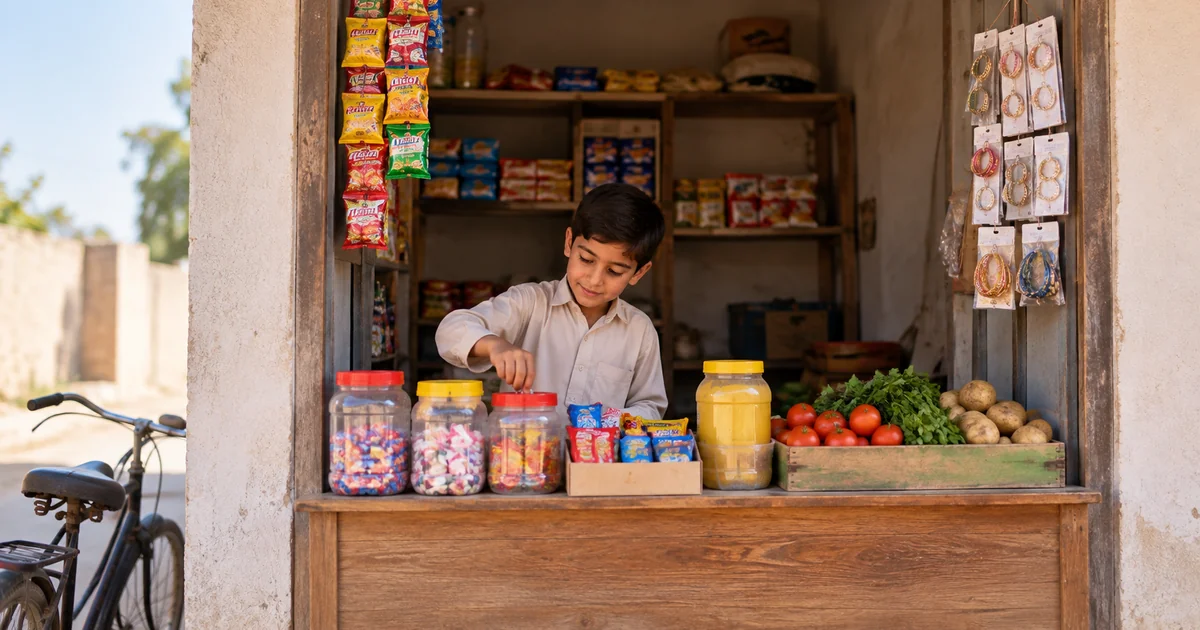
When I first started selling confectionery items from our home, I was not trying to build a particular type of retail business.
I was a child, still in primary school, and the business was simple.
There were confectionery products to sell, and there was a room in our family home facing the public way that gradually became a small shop.
But something interesting happened after that.
The shop did not remain only a confectionery shop.
Over time, I added vegetable ghee, vegetables, and even small fashion items such as women’s rings.
Looking back, that change taught me a lesson I understand much better today:
The first version of a business does not always define what the business has to become.
Sometimes growth is not about making the original idea bigger. It is about allowing the business itself to become broader.
The Business Changed Before I Had a Name for the Change
At that age, I did not know terms such as product diversification, retail assortment, or business model evolution.
I was simply selling different kinds of products from a small room.
But viewed from an entrepreneurial perspective today, there was an important transition taking place.
I had started with one clear category: confectionery.
Later, the same small shop contained products from completely different categories.
Vegetable ghee was not confectionery.
Vegetables were not confectionery.
Women’s rings were obviously not confectionery either.
If I had decided that the business must always remain a “confectionery business,” those additions would have looked strange.
But a business does not have to remain trapped inside the description of its first product.
That is the first lesson I take from this part of my childhood experience.
Your First Product Is Not Your Business Identity
Founders can become emotionally attached to the first version of an idea.
You start selling one product, so you begin thinking of yourself as someone who sells that product.
You start offering one service, so the service becomes the identity of the entire company.
That can eventually create an invisible boundary.
“I am in this business, so I should only do this.”
My tiny shop developed differently.
Confectionery was where it started, but it did not become a permanent rule about what the shop was allowed to sell.
Today, I would describe the business more broadly.
It was a tiny retail operation being run from one room.
That description leaves far more room for evolution than calling it only a confectionery shop.
This distinction can matter for any entrepreneur.
The first thing you sell may simply be your entry point.
It does not necessarily have to become the permanent definition of the company.
Growing Wider Is Different From Growing Bigger
When people talk about business growth, the picture is often physical.
A bigger shop.
More locations.
More employees.
A larger office.
A bigger warehouse.
But the shop from my childhood reminds me that growth can take another form.
A business can become broader without immediately becoming physically larger.
The same room can represent a different business over time because the scope of what happens inside it changes.
That is what happened in my case.
The interesting change was not that the room suddenly became large.
It was still a small space.
What changed was the range of business activity taking place inside it.
This is a useful distinction for small entrepreneurs because growth should not always be interpreted as expansion of premises.
Sometimes the next stage is an expansion of capability.
You learn to handle another type of product.
You understand another category.
You deal with a different type of purchase.
You become comfortable operating beyond the narrow boundaries of where you started.
The business becomes wider before it becomes bigger.
Different Products Create Different Business Problems
One aspect of this story becomes much clearer to me as an adult.
Selling several product categories is not simply the same activity repeated with different objects.
Consider the categories I had in that small shop.
Confectionery products behave differently from vegetables.
Vegetables behave differently from vegetable ghee.
And all of those are completely different from women’s rings.
They differ in how they are handled, displayed, purchased, stored, presented, and sold.
This means that every time a small retailer enters another category, the business becomes more complex.
That complexity is easy to underestimate.
Adding a product may take only a small amount of physical space, but adding a category can require a completely different way of thinking.
This is one reason product diversification should not simply mean collecting more things to sell.
The owner has to be capable of operating the broader business that those products create.
Product Diversification Can Change the Owner Too
There is another side to diversification that receives less attention.
The business changes, but the entrepreneur changes as well.
When you remain inside one narrow category, you repeatedly solve similar problems.
When you work across different categories, you begin encountering different situations.
That can make you more adaptable.
My childhood shop exposed me to more than one type of retail product very early.
I was not studying retail theory.
I was experiencing the practical reality that business does not always arrive in neat categories.
This is still relevant for entrepreneurs today.
A founder may begin by describing the company very narrowly because that makes the idea easier to understand.
That can be useful at the beginning.
But there is a difference between clarity and rigidity.
Clarity tells you what you are doing now.
Rigidity tells you that you are never allowed to become anything else.
Those are not the same thing.
Flexibility Does Not Mean Selling Everything
There is an important limit to this lesson.
Being flexible does not mean a business should become random.
A company that keeps entering unrelated areas without a clear reason can lose its identity and become increasingly difficult to operate.
That is not strategic diversification.
It is distraction.
If I were expanding a small retail business today, I would ask a different set of questions before entering another category.
Does the new category still fit the business I want to operate?
A new product can look attractive while quietly pulling the company toward a completely different type of business.
Understand that change before making it.
What new complexity comes with this category?
Think beyond the product itself.
Consider handling, storage, presentation, sourcing, shelf life, after sales requirements, and the knowledge needed to sell it properly.
Can I operate two categories well at the same time?
The ability to start something is different from the ability to manage it alongside everything else.
Is the business becoming broader or simply becoming confusing?
There should still be a clear reason for everything the company does.
These questions are much more useful than simply asking, “Can I sell this too?”
Almost anything can be added.
The better question is whether it belongs inside the business you are trying to build.
A Simple Way to Think About Business Scope
If I were advising someone running a tiny shop today, I would suggest defining the business on three levels.
Level 1: What do you sell today?
Be specific.
For example, confectionery products.
Level 2: What broader type of business are you actually operating?
For example, a small local retail shop.
This broader definition gives the company room to change.
Level 3: What do you not want the business to become?
This is equally important.
Expansion becomes easier to manage when you also know your boundaries.
Without boundaries, flexibility can turn into constant distraction.
A founder needs enough openness to evolve and enough discipline to know when an opportunity belongs somewhere else.
What I Would Understand Differently Today
As a child, I was not consciously building a diversified retail strategy.
I would not rewrite my past and pretend otherwise.
I was simply running a very small business and gradually selling more types of products.
The strategic interpretation came much later.
Today, I understand that one of the hardest things for an entrepreneur is deciding which parts of the original business are permanent and which parts are temporary.
Your first product can be temporary.
Your first location can be temporary.
Your first way of describing the business can be temporary.
Even your understanding of what business you are actually in can change.
The important thing is not to confuse the starting point with the final identity.
One Room Can Contain More Than One Version of a Business
When I think about that small room today, I do not only remember a place where confectionery items were sold.
I see several versions of a tiny business existing in the same space.
First, there was a simple confectionery operation.
Then the product range became broader.
The physical room remained small, but the scope of the business changed.
That experience gave me an early lesson that I can now put into words:
A business can outgrow its original definition before it outgrows its physical space.
For entrepreneurs, that creates both an opportunity and a responsibility.
The opportunity is to remain flexible enough to evolve.
The responsibility is to make sure each expansion still belongs inside a business you are capable of operating well.
Your first idea gives you somewhere to begin.
It does not have to decide everything that comes after it.
Frequently Asked Questions
What is product diversification in a small retail business?
Product diversification means expanding beyond the original product or category a business started with. For a small retailer, this may involve introducing additional categories while continuing to operate the original part of the business.
Can a small shop sell products from different categories?
Yes. A small shop can operate across several categories, but each additional category can create new operational requirements. The owner should consider whether the broader range still forms a manageable and understandable business.
When does diversification become a distraction?
Diversification becomes a distraction when new categories consume attention and resources without fitting the direction of the business. More products do not automatically create a stronger company.
Does business growth always require a bigger location?
No. A business can develop through a wider range of capabilities, products, processes, or services before it requires larger premises. Physical expansion is only one form of business growth.
The Lesson I Kept
That one room taught me something different from simply how to sell confectionery.
It showed me that businesses are allowed to change.
The product that gets you started does not need to become a cage around everything you build afterward.
But flexibility needs direction.
A useful founder is not someone who says yes to every possible expansion.
It is someone who understands when the business is genuinely evolving and when it is simply becoming unfocused.
My little shop changed categories long before I understood any of this formally.
Years later, I can see the lesson much more clearly.
Start with a definition.
Build within it.
And when the business begins to become something broader, be willing to reconsider the definition itself.